Speak Less, Command More: The Ancient Body Language Secrets Lucknow's Women Used to Run Every Room
Here's something nobody puts in a leadership seminar: the most powerful thing you can do in a room is not explain yourself.
Lucknow's historical women — the begums, the poets, the tawa'if who held salons that shaped entire political dynasties — understood this at a cellular level. In a world that constantly tried to limit what they could say out loud, they built a second language. One made of glances, posture, ornamentation, and the studied deployment of stillness. It was sophisticated. It was deliberate. And it worked so well that men with considerably more institutional power often left those rooms having done exactly what these women intended — without ever realizing a negotiation had taken place.
We're not talking about tricks. We're talking about a full, layered system of communication that Lucknow's culture refined over centuries. And if you've ever felt like you're constantly over-explaining yourself in meetings, on dates, or at family dinners where someone keeps asking when you're getting married — this one's for you.
The Nazar: Why Your Eyes Are Your Most Underused Asset
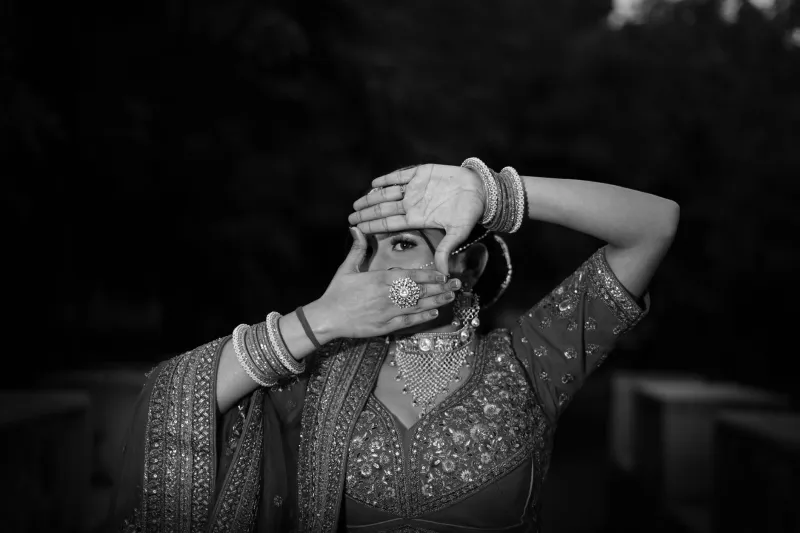
In Lucknow's courtly tradition, the nazar — the gaze — was never casual. Where you looked, how long you held it, when you chose to look away — each beat carried meaning. A glance held a half-second too long was an invitation. A glance dropped deliberately was a dismissal. Eyes that moved slowly communicated control; eyes that darted signaled anxiety.
Modern research has basically confirmed what Lucknow already knew. Studies on perceived authority consistently show that people who maintain steady, intentional eye contact are rated as more competent, more trustworthy, and yes — more powerful. But the key word is intentional. There's a difference between staring someone down and the kind of calm, unhurried eye contact that says I see you, and I'm not rushed by anything you're doing.
Practice it. In your next Zoom call, resist the reflex to look away when someone challenges you. Hold the gaze for just a beat longer than feels comfortable. You'll feel the shift in the room — even through a screen.
The Jewelry Wasn't Decoration. It Was a Statement.
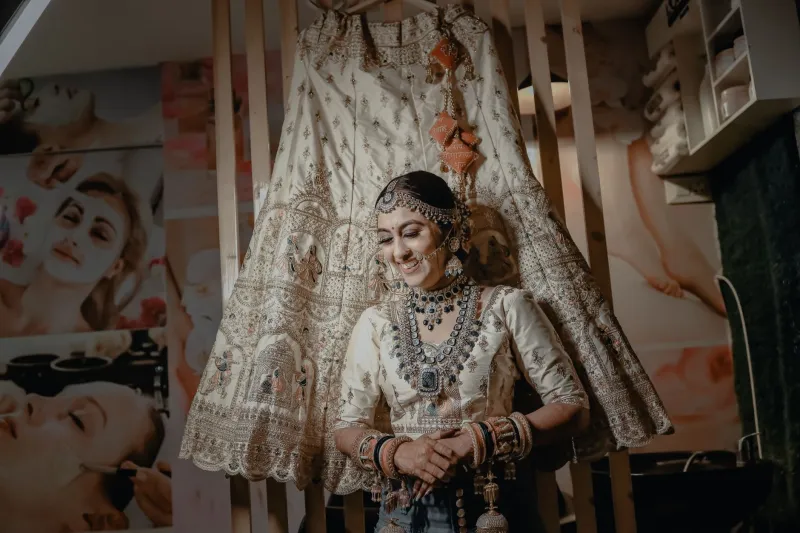
This might be the part that surprises you most: in Lucknow's cultural framework, what a woman wore — and how she wore it — was a form of active communication, not passive adornment.
The choice to wear heavy, audible bangles to a meeting where someone expected you to be quiet? Intentional. Every movement announced itself. The deliberate stillness of keeping those same bangles silent when silence served better? Also intentional. Jewelry that clinked when you moved your hands while speaking drew the eye downward — a subtle way of directing attention without raising your voice.
Lucknow's artisans didn't just create beautiful objects. They created tools. And the women who wore them understood that ornamentation could amplify presence or sharpen mystery depending entirely on how it was used.
You don't need to run out and buy a full set of gold bangles (though honestly, no one would stop you). The principle translates: be deliberate about what you wear to high-stakes situations and what message it sends before you've opened your mouth. Your appearance is already communicating. The question is whether you're directing that conversation or leaving it to chance.
Posture as Power: The Architecture of Authority
Lucknow's culture of tehzeeb — that famous refinement that the city is still known for — was often misread by outsiders as passivity. It wasn't. The upright spine, the unhurried movement, the deliberate way of occupying space — these were signals of self-possession, not submission.
There's a particular quality to how a woman moves when she is completely unbothered by whether she's being watched. It's not performance. It's the absence of performance — and it reads, to everyone in the room, as authority.
Compare that to the way most of us were socialized to take up space: smaller, apologetic, angled toward whoever seems most important. We learn to make ourselves easier to overlook, and then we're confused when we get overlooked.
The women of Lucknow's salons and courts didn't angle toward power. They let power come to them. The posture that communicated this wasn't aggressive — it was simply settled. Shoulders back not in a military way, but in a I have been here before and I will be here after you leave way. It's a distinction that's hard to put into words but immediately legible to anyone in the room.
Strategic Stillness: The Pause That Changes Everything
We are terrified of silence. American culture especially — we fill every gap, rush to answer, apologize for pauses that last more than two seconds. And that reflex costs us, constantly.
In Lucknow's conversational tradition, a well-timed silence wasn't awkward. It was a move. The pause before answering a question communicated that you were not reactive — that you processed on your own timeline, not the other person's. The pause after being challenged communicated that the challenge hadn't rattled you. The pause before agreeing to something made the agreement feel considered rather than automatic.
This is something therapists and negotiators have figured out independently: silence forces the other person to keep talking. And the person who keeps talking is usually the one who ends up making concessions.
Lucknow's women had been running this play for centuries before anyone gave it a name.
Bringing It Into Your Actual Life
So what does this look like on a Tuesday in 2025, when you're navigating a performance review, a difficult family dinner, or a date where someone keeps interrupting you?
It looks like this: you stop filling every silence with reassurance. You let your gaze be steady and unhurried instead of searching for approval. You take up the physical space you're entitled to without apologizing for it. You let your pause say I'm thinking instead of I'm anxious. You choose what you wear with intention, not as an afterthought.
None of this requires a script. It doesn't require you to be louder or more aggressive or more anything. It requires you to be more still — which, counterintuitively, is the harder thing for most of us.
Lucknow's most powerful women operated in rooms where they were frequently underestimated, underpaid in social currency, and structurally limited. They didn't wait for the rules to change. They built a parallel system of communication that worked within those constraints while quietly subverting them.
That's not a historical footnote. That's a blueprint.
And the beautiful thing about a language built on stillness and intention? Nobody can take it from you. It's already yours — you just have to stop talking long enough to use it.