Stop Shrinking: How Lucknow's Most Legendary Women Taught the World That 'Too Much' Is Just Enough

Somewhere between your third performance review and the tenth time a man talked over you in a meeting, someone probably told you to "dial it back." Maybe it was framed nicely — you come on a little strong — or maybe it was wrapped in a compliment that still managed to sting. Either way, the message was the same: you are too much. Shrink.
Here's what they didn't tell you: there's an entire city — centuries deep — that would have laughed at that note.
Welcome to Lucknow. Population: women who never got that memo.
The City That Was Built for Boldness
Lucknow, the capital of Uttar Pradesh in northern India, is a place that has always operated on its own terms. Known for its tehzeeb — a layered, deeply intentional form of etiquette and grace — the city is often misread by outsiders as a place of quiet compliance. That reading couldn't be more wrong.
Tehzeeb was never about shrinking. It was about presence. The women who embodied it most fully were the ones who knew exactly how much space they were entitled to occupy — and occupied every inch of it, deliberately and without apology.
"There's a fundamental misunderstanding of what Lucknow's feminine ideal actually looked like," says Dr. Priya Mehrotra, a cultural historian who specializes in the social history of Awadh. "The women who were most revered — the poets, the courtesans, the begums — they weren't celebrated despite being intense, opinionated, and fully themselves. They were celebrated because of it. Fullness was the standard."
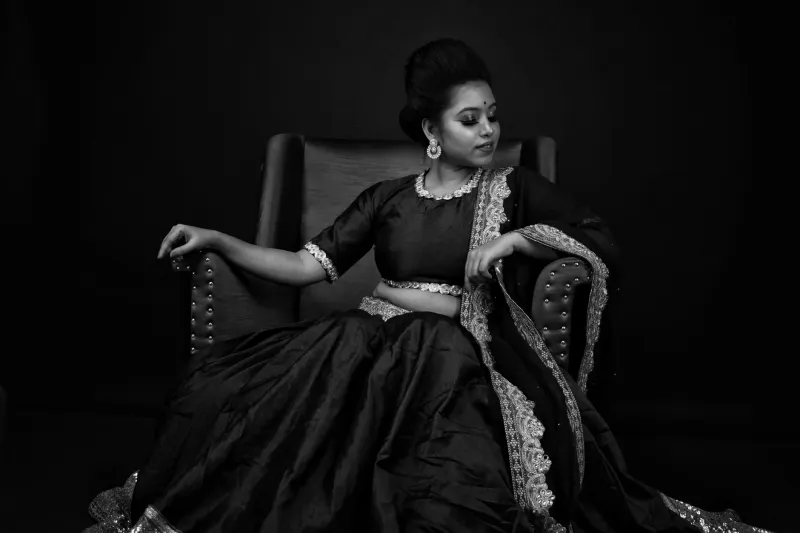
That fullness showed up everywhere. In the way a tawa'if commanded a mehfil — a gathering of Lucknow's most powerful men — not by being agreeable, but by being undeniably, magnetically herself. In the way Begum Hazrat Mahal stood before colonial forces in 1857 and chose resistance when every political calculation said to yield. In the way Lucknow's female poets wrote verses so sharp they could draw blood, and the culture didn't flinch — it applauded.
The Likability Trap Is a Very American Problem
Fast forward to 2025, and American women are still navigating what researchers have been calling the "likability trap" for decades. The data is exhausting in its consistency: women who advocate for themselves are rated as less likable than men who do the same. Women who speak confidently are perceived as aggressive. Women who take up space — physically, verbally, professionally — are penalized in ways their male counterparts simply aren't.
And so the training begins early. Soften your email tone. Add a smiley face. Start with "I'm sorry to bother you, but..." End with "...just a thought!" Perform smallness so convincingly that people forget you had a point.
"I spent the first decade of my career being incredibly good at making other people comfortable with my ambition," says Anika Rao, a Chicago-based attorney who grew up in a South Asian household with deep roots in Lucknow. "I'd preface everything. I'd over-explain. I'd laugh at the right moments so nobody felt threatened. And I was good at it — which was the most depressing part."
Anika's turning point came during a trip to Lucknow in her early thirties, when she spent time with older women in her family — women who had navigated their own constraints but had never once performed smallness. "My great-aunt is in her eighties and she will tell you. No apology, no softening. And everyone in the room respects her completely. I came back to Chicago and I thought: I have been lying about who I am for ten years."
'Too Much' Was Always a Compliment in Disguise
The women of Lucknow's golden era understood something that modern self-help culture is only just beginning to articulate: being "too much" is only a problem for people who benefit from you being less.
The tawa'if — Lucknow's legendary courtesans, who were also poets, musicians, and political influencers — were never asked to be palatable. They were trained in the art of being unforgettable. Their opinions were sought. Their wit was prized. Their refusal to perform deference was, paradoxically, the source of their power.
"The tawa'if didn't just entertain — she set the cultural standard," says Dr. Mehrotra. "Lucknow's nawabs consulted them on matters of taste, of politics, of language itself. You don't get that kind of influence by making yourself small. You get it by being so thoroughly, undeniably yourself that people have no choice but to reckon with you."
This is the paradox at Lucknow's cultural core: a city famous for its refinement produced women who were anything but restrained in the ways that mattered. The grace was real — but it was never a cage. It was a frame for power, not a substitute for it.
Reclaiming Your Fullness in a World That Keeps Asking for Less
For American women raised on a diet of "be likable, be agreeable, be easy," the Lucknow model isn't just inspiring — it's almost disorienting. What does it actually look like to stop shrinking?
Jasmine Okafor, a New York-based brand strategist who has studied Lucknow's cultural history as part of her broader research into women's leadership, has some thoughts. "It starts with noticing where you're performing smallness that you don't actually feel," she says. "The unnecessary apologies. The opinions you swallow in meetings. The ambitions you describe in half-sentences so nobody gets intimidated. That's the inventory."
From there, she argues, it's about reframing the feedback. "When someone tells you that you're 'a lot,' or 'too intense,' or 'too direct' — that is not a personality diagnosis. That is one person's discomfort with your power. Those are two completely different things, and conflating them is how women end up editing themselves for thirty years."
Anika, for her part, says the shift wasn't dramatic — but it was irreversible. "I stopped preemptively apologizing for my opinions. I stopped laughing to make men comfortable. I stopped shrinking my ambitions to a size that would fit in someone else's comfort zone. And the sky didn't fall. Some people were annoyed. The right people respected me more."
The Queen Standard
Here's what Lucknow always knew, and what the rest of the world is slowly catching up to: a woman who is fully herself — opinionated, bold, unapologetically present — is not a problem to be managed. She is a force to be reckoned with.
The city's history is full of women who were told, implicitly or explicitly, that their fullness was inconvenient. And its history is equally full of women who responded to that message by being even more themselves, with more intention, more precision, and considerably more style.
You were not built to be palatable. You were built to be powerful.
Lucknow figured that out centuries ago. The rest of us are just catching up.