She Said No — and That Was the Whole Point: What Lucknow's Tawa'if Knew About Boundaries That Modern Women Are Still Learning
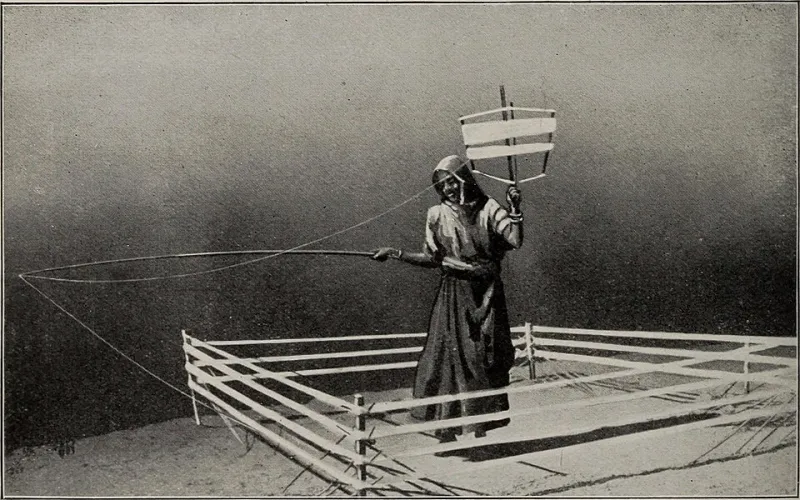
Photo: Internet Archive Book Images, No restrictions, via Wikimedia Commons
Somewhere between the self-help shelves at Barnes & Noble and the latest boundary-setting reel going viral on Instagram, American women are searching — hard — for a framework that actually holds up in real life. One that works when your boss guilt-trips you into unpaid overtime. One that works when a partner chips away at your sense of self, slowly, so you almost don't notice. One that works when the world keeps telling you that your 'no' needs a justification attached.
Here's the thing: the framework already exists. It just comes from a place most people wouldn't expect — the mehfils and kothas of 18th and 19th century Lucknow, where a class of extraordinary women called the tawa'if didn't just survive a patriarchal world. They outmaneuvered it.
Who Were the Tawa'if, Really?
Let's clear something up immediately, because history has not been kind in its framing. The tawa'if were not what colonial-era records — or Bollywood, frankly — reduced them to. Yes, they were courtesans. But the word carries none of the complexity it should.
These were women who were, by the standards of their era, among the most educated and economically autonomous people in Lucknow. They were fluent in Urdu poetry, classical music, and the refined art of adab — a cultural philosophy of grace and mutual respect that governed every interaction. They ran their own households. They managed their own finances. They chose — and this is the part that still feels radical — which patrons were worthy of their time.
Let that land for a second. In a world that offered women almost no structural power, the tawa'if built their own structures. And at the foundation of every single one was an unshakeable understanding of their own value.
The Economics of Self-Respect
One of the most striking things about how tawa'if operated was their relationship with money — not just earning it, but controlling it. Senior courtesans, known as chaudharains, held authority over entire households and made financial decisions independently. They weren't waiting for permission. They weren't asking for a seat at the economic table. They built the table, set the prices, and decided who got to sit down.
This isn't a small thing. Even today, in 2025, women in the US earn roughly 84 cents for every dollar a man makes. Women — especially women of color — still navigate workplaces where their compensation is treated as negotiable in ways men's simply aren't. The tawa'if didn't negotiate from a place of scarcity or apology. They negotiated from a place of established, non-negotiable worth.
The psychology here is profound. When you've already decided what you're worth, you're not bargaining. You're simply stating terms.
'No' as an Art Form
Here's where it gets really interesting. The tawa'if didn't just say no — they made the act of refusal into something almost architectural. It was deliberate, graceful, and completely final.
In the culture of the kotha, a tawa'if's rejection of a patron wasn't a moment of conflict. It was a demonstration of discernment. And discernment, in that world, was a marker of status. The woman who accepted everyone was worth less, culturally and economically, than the woman who chose carefully. Selectivity was the signal.
Compare that to how American women are still conditioned to refuse things. We apologize before we say no. We over-explain. We soften it with 'maybe another time' when we mean 'absolutely not.' We worry about being perceived as difficult, cold, or — that old reliable — a word that rhymes with 'witch.'
The tawa'if had no patience for that performance. Their 'no' didn't come with a footnote. It came with the quiet confidence of a woman who had already done the internal work of knowing her value wasn't contingent on anyone else's approval.
Adab: The Philosophy That Made It All Work
You can't talk about the tawa'if without talking about adab. It's a concept that doesn't translate cleanly into English — it's somewhere between etiquette, respect, and a kind of moral elegance. And it was the operating system underneath everything the tawa'if did.
Adab meant that every interaction had a code. There were expectations on both sides. A patron who didn't meet the standard of conduct wasn't just unwelcome — he was simply not relevant. The tawa'if didn't rage against disrespect. They didn't beg for better treatment. They simply removed access.
This is genuinely radical, even now. So much of the conversation around boundaries in contemporary American culture focuses on the emotional labor of explaining the boundary — the therapy-speak, the 'I feel' statements, the careful articulation of why you need what you need. And look, that work has its place. But the tawa'if model suggests something more efficient: you don't owe anyone a detailed explanation of your standards. You simply have them, and you hold them.
What This Looks Like in a Modern American Life
So what does any of this look like when you're not a 19th century courtesan in Lucknow but a woman in Chicago navigating a toxic work environment, or a woman in Atlanta trying to exit a relationship that's been slowly draining her sense of self?
It looks like knowing your number before you walk into a salary negotiation — and not moving from it because someone sighs heavily or gives you a look. It looks like deciding in advance which behaviors you will and won't accommodate in a relationship, and treating that decision as settled rather than constantly up for renegotiation. It looks like understanding that when you make yourself endlessly available, endlessly flexible, and endlessly accommodating, you're not being generous — you're signaling that your time and energy have no floor price.
The tawa'if understood that scarcity creates value. Not artificial scarcity — not game-playing — but the genuine scarcity that comes from a woman who actually has standards and actually keeps them.
Reclaiming the Legacy
There's an irony in the fact that the tawa'if — women who were marginalized, stigmatized, and eventually decimated by colonial-era legislation that criminalized their entire way of life — are now the ones with something to teach us about power. History tried to erase them. What it couldn't erase was the philosophy they embodied.
For American women, especially women who feel like they're constantly fighting to be taken seriously in spaces that weren't built for them, there's something genuinely nourishing about this legacy. These were women who didn't wait for the culture to validate their worth. They decided it themselves, built systems around it, and lived accordingly.
That's not a historical curiosity. That's a blueprint.
The Queen of Lucknow isn't a metaphor. She's a lineage. And you're already in it.